
1. Problem
Let P be an interior point of a triangle ABC and AP, BP, CP meet the sides BC, CA, AB in D, E, F respectively. Show that

2. Solution
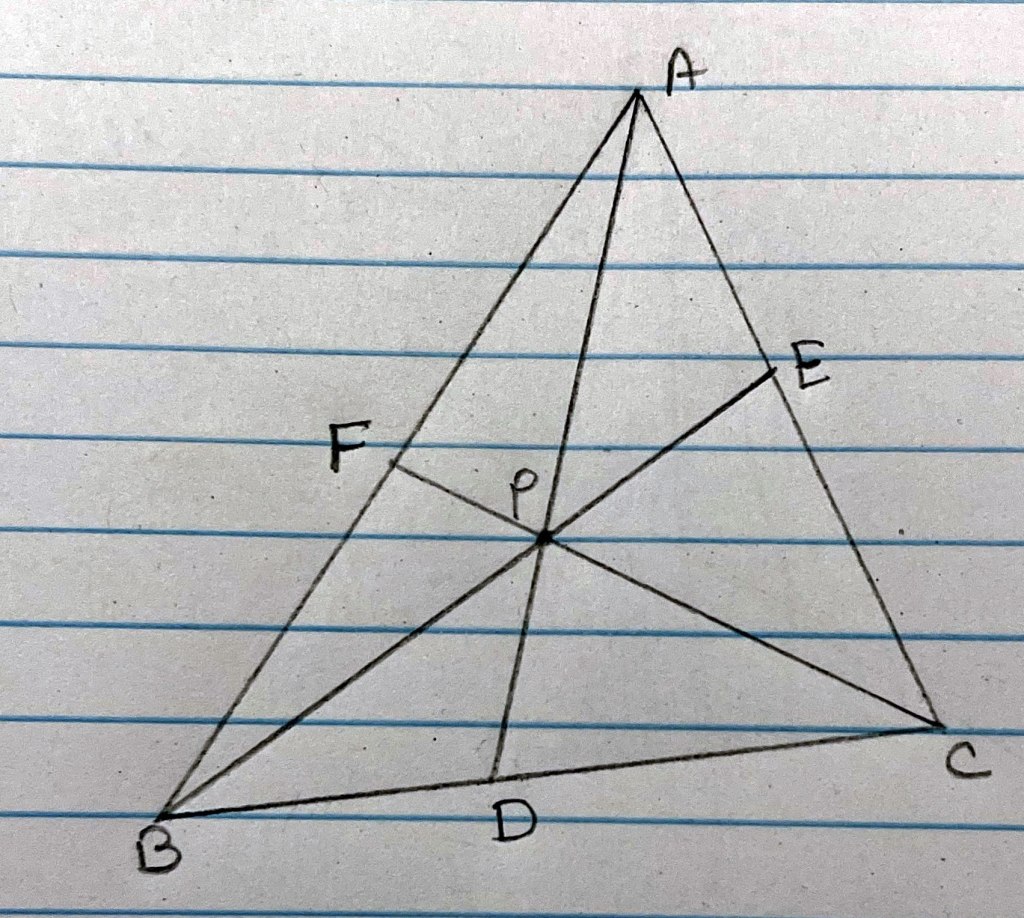
Proof:
![{\mathbf{[\Gamma]}}](https://s0.wp.com/latex.php?latex=%7B%5Cmathbf%7B%5B%5CGamma%5D%7D%7D&bg=ffffff&fg=000000&s=0&c=20201002)

Since height from C to base is same for both 
![\displaystyle \frac{AF}{FB} = \frac{[AFC]}{[BFC]} \ \ \ \ \ (2)](https://s0.wp.com/latex.php?latex=%5Cdisplaystyle+%5Cfrac%7BAF%7D%7BFB%7D+%3D+%5Cfrac%7B%5BAFC%5D%7D%7B%5BBFC%5D%7D+%5C+%5C+%5C+%5C+%5C+%282%29&bg=ffffff&fg=000000&s=0&c=20201002)
Since height from P to base is same for both
![\displaystyle \frac{AF}{FB} = \frac{[AFP]}{[BFP]} \ \ \ \ \ (3)](https://s0.wp.com/latex.php?latex=%5Cdisplaystyle+%5Cfrac%7BAF%7D%7BFB%7D+%3D+%5Cfrac%7B%5BAFP%5D%7D%7B%5BBFP%5D%7D+%5C+%5C+%5C+%5C+%5C+%283%29&bg=ffffff&fg=000000&s=0&c=20201002)
![\displaystyle \frac{AF}{FB} = \frac{[AFC] - [AFP]}{[BFC] - [BFP]} = \frac{[APC]}{[BPC]} \ \ \ \ \ (4)](https://s0.wp.com/latex.php?latex=%5Cdisplaystyle+%5Cfrac%7BAF%7D%7BFB%7D+%3D+%5Cfrac%7B%5BAFC%5D+-+%5BAFP%5D%7D%7B%5BBFC%5D+-+%5BBFP%5D%7D+%3D+%5Cfrac%7B%5BAPC%5D%7D%7B%5BBPC%5D%7D+%5C+%5C+%5C+%5C+%5C+%284%29&bg=ffffff&fg=000000&s=0&c=20201002)
similarly if we apply same formulas for E point
![\displaystyle \frac{AE}{EC} = \frac{[AEB]}{[CEB]} = \frac{[AEP]}{[CEP]}=\frac{[AEB] - [AEP]}{[BEC] - [CEP]} = \frac{[APB]}{[BPC]} \ \ \ \ \ (5)](https://s0.wp.com/latex.php?latex=%5Cdisplaystyle+%5Cfrac%7BAE%7D%7BEC%7D+%3D+%5Cfrac%7B%5BAEB%5D%7D%7B%5BCEB%5D%7D+%3D+%5Cfrac%7B%5BAEP%5D%7D%7B%5BCEP%5D%7D%3D%5Cfrac%7B%5BAEB%5D+-+%5BAEP%5D%7D%7B%5BBEC%5D+-+%5BCEP%5D%7D+%3D+%5Cfrac%7B%5BAPB%5D%7D%7B%5BBPC%5D%7D+%5C+%5C+%5C+%5C+%5C+%285%29&bg=ffffff&fg=000000&s=0&c=20201002)
Now, adding equation (4) and (5)
![\displaystyle \frac{AF}{FB} + \frac{AE}{EC} = \frac{[APC]}{[BPC]} + \frac{[APB]}{[BPC]} + 1 -1](https://s0.wp.com/latex.php?latex=%5Cdisplaystyle+%5Cfrac%7BAF%7D%7BFB%7D+%2B+%5Cfrac%7BAE%7D%7BEC%7D+%3D+%5Cfrac%7B%5BAPC%5D%7D%7B%5BBPC%5D%7D+%2B+%5Cfrac%7B%5BAPB%5D%7D%7B%5BBPC%5D%7D+%2B+1+-1+&bg=ffffff&fg=000000&s=0&c=20201002)
![\displaystyle \frac{AF}{FB} + \frac{AE}{EC} = \frac{[APC]+[APB]+[BPC]}{[BPC]} -1](https://s0.wp.com/latex.php?latex=%5Cdisplaystyle+%5Cfrac%7BAF%7D%7BFB%7D+%2B+%5Cfrac%7BAE%7D%7BEC%7D+%3D+%5Cfrac%7B%5BAPC%5D%2B%5BAPB%5D%2B%5BBPC%5D%7D%7B%5BBPC%5D%7D+-1+&bg=ffffff&fg=000000&s=0&c=20201002)
![\displaystyle \frac{AF}{FB} + \frac{AE}{EC} = \frac{[ABC]}{[BPC]} - 1](https://s0.wp.com/latex.php?latex=%5Cdisplaystyle+%5Cfrac%7BAF%7D%7BFB%7D+%2B+%5Cfrac%7BAE%7D%7BEC%7D+%3D+%5Cfrac%7B%5BABC%5D%7D%7B%5BBPC%5D%7D+-+1+&bg=ffffff&fg=000000&s=0&c=20201002)


In above proof we have used below equation, explanation can be found in Lemma 2 below,
![\displaystyle \frac{[ABC]}{[BPC]} = \frac{AD}{PD} \ \ \ \ \ (6)](https://s0.wp.com/latex.php?latex=%5Cdisplaystyle+%5Cfrac%7B%5BABC%5D%7D%7B%5BBPC%5D%7D+%3D+%5Cfrac%7BAD%7D%7BPD%7D+%5C+%5C+%5C+%5C+%5C+%286%29&bg=ffffff&fg=000000&s=0&c=20201002)

3. Extra Explanation
3.1. explanation equation (2)
![\displaystyle \frac{BD}{DC} = \frac{[ABD]}{[ADC]} \ \ \ \ \ (7)](https://s0.wp.com/latex.php?latex=%5Cdisplaystyle+%5Cfrac%7BBD%7D%7BDC%7D+%3D+%5Cfrac%7B%5BABD%5D%7D%7B%5BADC%5D%7D+%5C+%5C+%5C+%5C+%5C+%287%29&bg=ffffff&fg=000000&s=0&c=20201002)
Proof: Let there be AX 

now,
![\displaystyle [ADC] = \frac{1}{2}*AX*DC](https://s0.wp.com/latex.php?latex=%5Cdisplaystyle+%5BADC%5D+%3D+%5Cfrac%7B1%7D%7B2%7D%2AAX%2ADC+&bg=ffffff&fg=000000&s=0&c=20201002)
![\displaystyle [ABD] = \frac{1}{2}*AX*BD](https://s0.wp.com/latex.php?latex=%5Cdisplaystyle+%5BABD%5D+%3D+%5Cfrac%7B1%7D%7B2%7D%2AAX%2ABD+&bg=ffffff&fg=000000&s=0&c=20201002)
from above equations:
![\displaystyle \frac{[ABD]}{[ADC]} = \frac{\frac{1}{2}*AX*BD}{\frac{1}{2}*AX*DC}](https://s0.wp.com/latex.php?latex=%5Cdisplaystyle+%5Cfrac%7B%5BABD%5D%7D%7B%5BADC%5D%7D+%3D+%5Cfrac%7B%5Cfrac%7B1%7D%7B2%7D%2AAX%2ABD%7D%7B%5Cfrac%7B1%7D%7B2%7D%2AAX%2ADC%7D&bg=ffffff&fg=000000&s=0&c=20201002)
![\displaystyle \frac{[ABD]}{[ADC]} = \frac{BD}{DC}](https://s0.wp.com/latex.php?latex=%5Cdisplaystyle+%5Cfrac%7B%5BABD%5D%7D%7B%5BADC%5D%7D+%3D+%5Cfrac%7BBD%7D%7BDC%7D&bg=ffffff&fg=000000&s=0&c=20201002)
3.2. explanation equation (6)
Lemma 2 Let there be an interior point P in
![\displaystyle \frac{[ABC]}{[BPC]} = \frac{AD}{PD} \ \ \ \ \ (8)](https://s0.wp.com/latex.php?latex=%5Cdisplaystyle+%5Cfrac%7B%5BABC%5D%7D%7B%5BBPC%5D%7D+%3D+%5Cfrac%7BAD%7D%7BPD%7D+%5C+%5C+%5C+%5C+%5C+%288%29&bg=ffffff&fg=000000&s=0&c=20201002)
Proof: Let there be AX
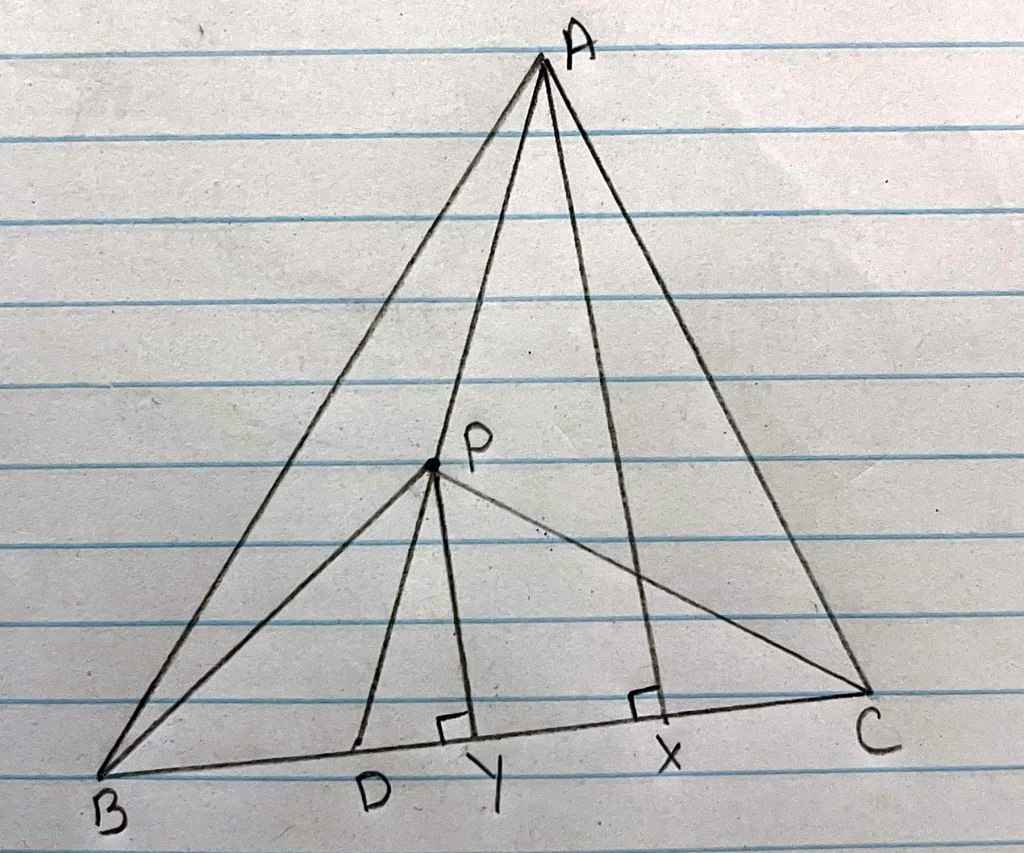
now,
![\displaystyle [ABC] = \frac{1}{2}*AX*BC](https://s0.wp.com/latex.php?latex=%5Cdisplaystyle+%5BABC%5D+%3D+%5Cfrac%7B1%7D%7B2%7D%2AAX%2ABC+&bg=ffffff&fg=000000&s=0&c=20201002)
![\displaystyle [BPC] = \frac{1}{2}*PY*BC](https://s0.wp.com/latex.php?latex=%5Cdisplaystyle+%5BBPC%5D+%3D+%5Cfrac%7B1%7D%7B2%7D%2APY%2ABC+&bg=ffffff&fg=000000&s=0&c=20201002)
from above equations:
![\displaystyle \frac{[ABC]}{[BPC]} = \frac{\frac{1}{2}*AX*BC}{\frac{1}{2}*PY*BC}](https://s0.wp.com/latex.php?latex=%5Cdisplaystyle+%5Cfrac%7B%5BABC%5D%7D%7B%5BBPC%5D%7D+%3D+%5Cfrac%7B%5Cfrac%7B1%7D%7B2%7D%2AAX%2ABC%7D%7B%5Cfrac%7B1%7D%7B2%7D%2APY%2ABC%7D+&bg=ffffff&fg=000000&s=0&c=20201002)
![\displaystyle \frac{[ABC]}{[BPC]} = \frac{AX}{PY}](https://s0.wp.com/latex.php?latex=%5Cdisplaystyle+%5Cfrac%7B%5BABC%5D%7D%7B%5BBPC%5D%7D+%3D+%5Cfrac%7BAX%7D%7BPY%7D+&bg=ffffff&fg=000000&s=0&c=20201002)
Since,


we can say 

Hence,
![\displaystyle \frac{[ABC]}{[BPC]} = \frac{AD}{PD}](https://s0.wp.com/latex.php?latex=%5Cdisplaystyle+%5Cfrac%7B%5BABC%5D%7D%7B%5BBPC%5D%7D+%3D+%5Cfrac%7BAD%7D%7BPD%7D&bg=ffffff&fg=000000&s=0&c=20201002)
4. Ceva’s Theorem
Theorem: The three lines containing the vertices A, B, and C of


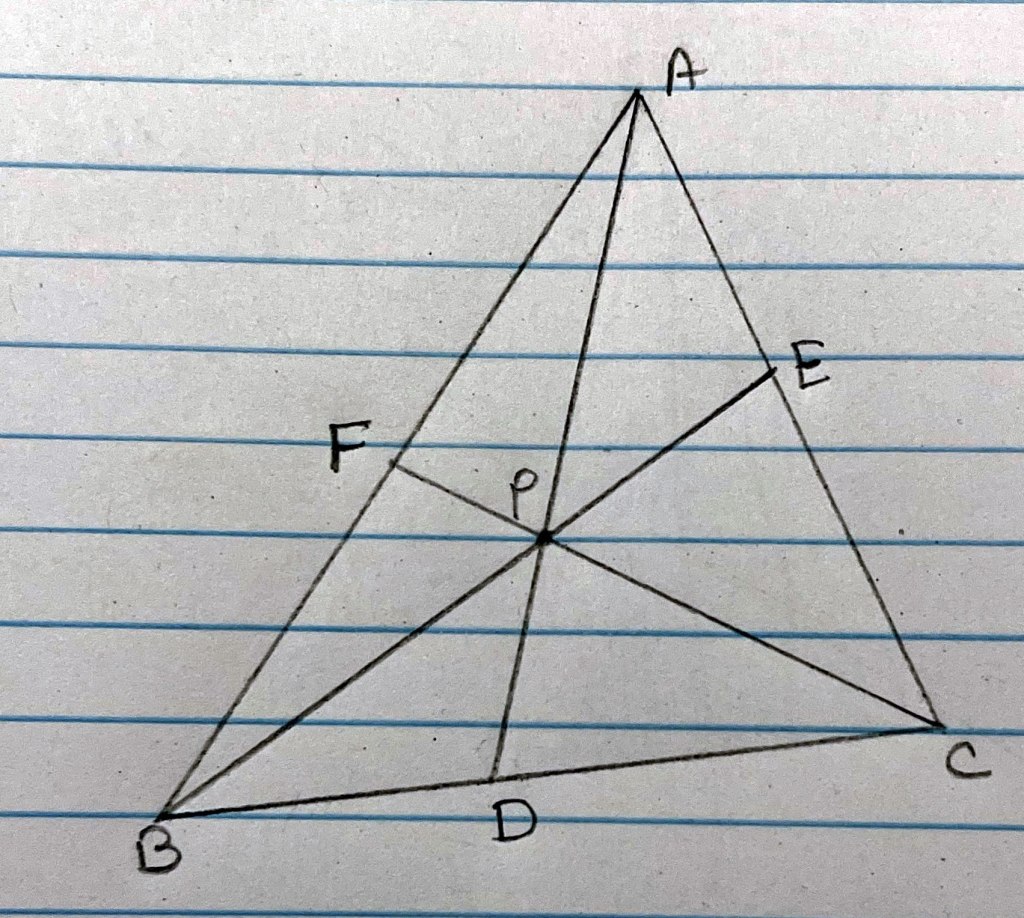
Proof:
Part 1: say line AD, BE and CF are concurrent at point P then prove
Proof: from Lemma 1,
similarly,
![\displaystyle \frac{BD}{DC} = \frac{[ABD]}{[ADC]}](https://s0.wp.com/latex.php?latex=%5Cdisplaystyle+%5Cfrac%7BBD%7D%7BDC%7D+%3D+%5Cfrac%7B%5BABD%5D%7D%7B%5BADC%5D%7D&bg=ffffff&fg=000000&s=0&c=20201002)
Therefore,
![\displaystyle \frac{BD}{DC} = \frac{[PBD]}{[PDC]}](https://s0.wp.com/latex.php?latex=%5Cdisplaystyle+%5Cfrac%7BBD%7D%7BDC%7D+%3D+%5Cfrac%7B%5BPBD%5D%7D%7B%5BPDC%5D%7D&bg=ffffff&fg=000000&s=0&c=20201002)
(Replace – sign with + sign if A and P are on opposite side of BC)
![\displaystyle \frac{BD}{DC} = \frac{[ABD]-[PBD]}{[ADC]-[PDC]}](https://s0.wp.com/latex.php?latex=%5Cdisplaystyle+%5Cfrac%7BBD%7D%7BDC%7D+%3D+%5Cfrac%7B%5BABD%5D-%5BPBD%5D%7D%7B%5BADC%5D-%5BPDC%5D%7D&bg=ffffff&fg=000000&s=0&c=20201002)
similarly,
![\displaystyle \frac{BD}{DC} = \frac{[APB]}{[APC]}](https://s0.wp.com/latex.php?latex=%5Cdisplaystyle+%5Cfrac%7BBD%7D%7BDC%7D+%3D+%5Cfrac%7B%5BAPB%5D%7D%7B%5BAPC%5D%7D&bg=ffffff&fg=000000&s=0&c=20201002)
![\displaystyle \frac{CE}{EA} = \frac{[BPC]}{[APB]}](https://s0.wp.com/latex.php?latex=%5Cdisplaystyle+%5Cfrac%7BCE%7D%7BEA%7D+%3D+%5Cfrac%7B%5BBPC%5D%7D%7B%5BAPB%5D%7D&bg=ffffff&fg=000000&s=0&c=20201002)
Multiplying 3 equations,
![\displaystyle \frac{AF}{FB} = \frac{[APC]}{[BPC]}](https://s0.wp.com/latex.php?latex=%5Cdisplaystyle+%5Cfrac%7BAF%7D%7BFB%7D+%3D+%5Cfrac%7B%5BAPC%5D%7D%7B%5BBPC%5D%7D&bg=ffffff&fg=000000&s=0&c=20201002)
Part 2: Now say we are given, The three lines containing the vertices A, B, and C of
![\displaystyle \frac{AF}{FB}*\frac{BD}{DC}*\frac{CE}{EA} =\frac{[APC]}{[BPC]} *\frac{[APB]}{[APC]}* \frac{[BPC]}{[APB]} = 1](https://s0.wp.com/latex.php?latex=%5Cdisplaystyle+%5Cfrac%7BAF%7D%7BFB%7D%2A%5Cfrac%7BBD%7D%7BDC%7D%2A%5Cfrac%7BCE%7D%7BEA%7D+%3D%5Cfrac%7B%5BAPC%5D%7D%7B%5BBPC%5D%7D+%2A%5Cfrac%7B%5BAPB%5D%7D%7B%5BAPC%5D%7D%2A+%5Cfrac%7B%5BBPC%5D%7D%7B%5BAPB%5D%7D+%3D+1&bg=ffffff&fg=000000&s=0&c=20201002)
then prove AD, CF and BE are concurrent.
Proof:
We are given,
Now say, AD and BE meet at point P and CP meets AB at F’ which is different from F, Then AD, BE and CF’ are concurrent. And from previous proof
from our hypothesis

But only one point can cut a line segment in given ratio so F = F’, so CF, CE and AD are concurrent

 The Mathematical Pursuit
Leave a comment